
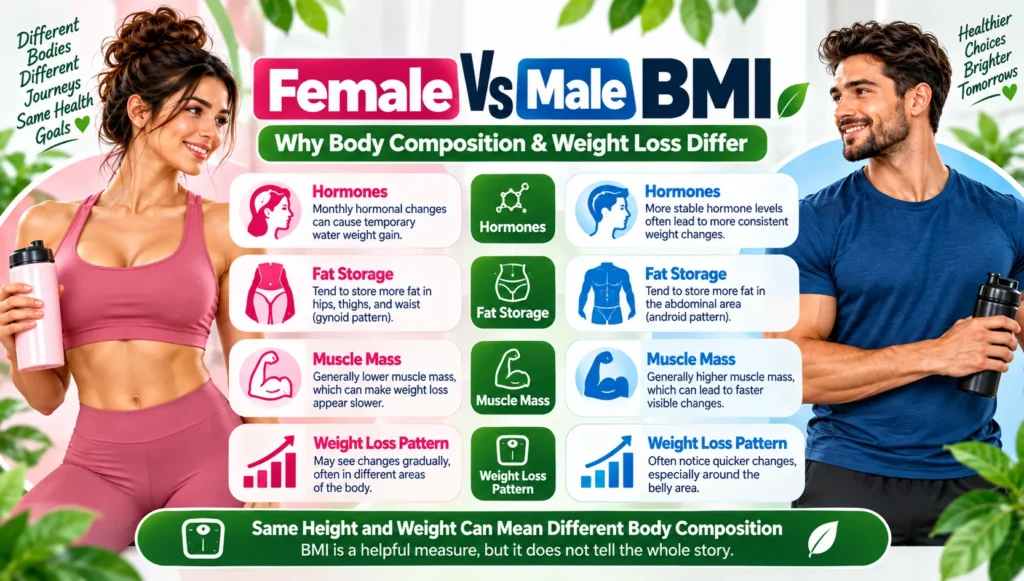
Women and men showing differences in body fat and muscle mass

Female Vs Male BMI: Why Body Composition & Weight Loss Differ

If the scale displays different results for a woman and a man with identical behavioral patterns, a situation of confusion can arise. The woman will see changes in her hip, thigh, or waist regions, while the man will observe quick changes in his belly region. Monthly hormonal fluctuations may lead to temporary water weight gain, which causes a slower progress rate. Female vs Male BMI helps explain why similar heights and weights do not always mean similar body composition. One can use BMI as a measure of health, but not everything. We will look at how hormones, fat storage, and muscle mass can affect weight-loss progress in women and men.

Why Does the Standard BMI Formula Treat Men and Women the Same?

The standard BMI formula uses the same calculation for men and women: weight divided by height squared, regardless of differences in body composition.

  • The formula to calculate BMI uses the equation of weight in kilograms divided by height in meters squared.
  • It does not measure the percentage of body fat in an individual.
  • Moreover, BMI cannot reveal where fat is located in the body.
  • Different people may have the same BMI but have varying body fat percentages.

Different people may have the same BMI but have varying body fat percentages. Because the math is identical for both sexes, you can check your baseline score on our primary BMI calculator for women.

Female vs Male Body Fat Distribution: What’s the Difference?

Body fat in women and men is stored in different places due to different hormone levels and body composition. Below is a table indicating the major differences in body fat distribution between females and males, with an indication of common storage sites for fat.

Essential Body Fat

Naturally higher

Naturally lower

Average Body Fat

Generally higher

Generally lower

Lean Muscle Mass

Generally lower

Generally higher

Main Hormonal Influence

Estrogen

Testosterone

Common Fat Storage

Hips, thighs, and buttocks

Abdomen

Energy Needs

Often lower on average

Often higher on average

Scale Fluctuations

Vary with menstrual-cycle-related fluid changes

Usually less affected by monthly hormonal cycles

Weight-Loss Pattern

Scale changes may appear slower

Scale changes may appear faster


Female Vs Male BMI Physiology: Why Body Composition Is Naturally Different

As everyone knows, there are natural differences in the development of muscle, fat, and lean mass between men and women. These Female vs. male BMI differences can affect energy needs and the way weight changes appear on the scale.

  • Women have more essential body fat because of reproductive functions.
  • Men have more lean mass due to the high level of testosterone.
  • The bigger muscle mass means higher energy needs.
  • Females have a tendency to store fat in regions like the hips, thighs, and buttocks, whereas men store their fat in the abdominal area. 
  • It could be that two individuals may have similar BMI levels, but different body compositions and body fat percentages. It is obvious that the application of Female vs Male BMI is not adequate for assessing people’s health.

How Hormones Affect Fat Storage in Women and Men

The hormones greatly impact how the fat is stored by the body and how the body changes its weight. It also has an impact on muscles, fluids, and fat deposits. Thus, Female Vs Male BMI might be similar, but the physical changes will not.

  • Fat Deposition and Estrogen in Females: Estrogen is associated with fat deposition around the hips, thighs, and buttocks. Post-menopausal low estrogen levels might cause increased fat deposition in the abdominal area.
  • Fat Deposition and Testosterone in Males: Testosterone promotes muscle growth and helps explain why men have more muscle mass. It might influence the appearance of any changes in weight or body shape.
  • Metabolism and Muscle Mass: Muscles consume calories even when the person is resting, although individual calorie requirements vary due to multiple factors. Individuals who have more muscle mass can have a higher metabolism rate.
  • Fat Deposition in Women versus Men: In females, there is usually subcutaneous fat deposition in the hips and thighs; in men, fat is deposited around the abdomen and waist.
  • Menstrual Hormonal Changes: Hormonal changes during the menstrual cycle can affect fluid retention and appetite. This may cause temporary changes in scale weight without a similar change in body fat.
  • Post-Menopausal Fat Deposits: Post-menopausal fat distribution is determined by changing estrogen levels and thus can alter fat-depositing patterns. The fat may build up at the waist regardless of slight fluctuations in body weight.

Why Comparing Your Weight-Loss Progress With Men Can Be Frustrating


There can be a feeling of discouragement when comparing your own journey to that of men due to the rate of change being different on the scale. The differences above help explain why men often have more muscle and higher average energy needs, while women may experience menstrual-related water changes. Fat distribution can also make visible changes appear in different areas. A woman may see the scale pause while body measurements are changing. Therefore, Female Vs Male BMI can look similar while the weight-loss experience is quite different. Longer trends give a clearer picture than weekly comparisons with others.

Better Ways for Women to Track Progress Beyond BMI

Because BMI leaves out several details, women may find a broader set of measurements more useful when following body changes. These measures connect with the hormone and fat-distribution differences above. Female Vs Male BMI is a starting point, while several signs together give more context.

  • Waist Measurement: The measurement of your waist can reveal any alteration that takes place in the area of your belly despite no variation in your total body weight. Make sure to measure your waist under similar circumstances each time.
  • Body Fat Percentage: Body-fat percentage gives more detail about fat and lean mass than BMI alone. Since results can vary by method, tracking with the same method helps show trends.
  • Notice Strength Changes: Strength can improve even when the scale changes slowly. Monitoring exercises, repetitions, or resistance can reveal progress that is impossible to detect with a standard Female vs Male BMI calculation.
  • Monthly Weight Trends: A single weigh-in can be influenced by food, fluid intake, digestion, or hormones. Analysis over a number of weeks provides a better perspective on weight trends.

Final Words

Female Vs Male BMI is calculated using the same formula, but the number itself does not tell the whole truth. The changes in muscle mass, hormone production, and fat accumulation can result in body composition disparity even if people have the same BMI. In order to get a fuller view, BMI can be calculated along with other characteristics such as waist circumference, body fat percentage, fitness level, and weight fluctuations.

Frequently Asked Questions

No, the formula used to calculate BMI remains constant for both genders. Even though body composition may vary, the same BMI will still exist.

Yes, BMI does not directly measure body-fat percentage or muscle mass. Two people with the same BMI can therefore have different body composition.

Women generally have less lean muscle and may experience menstrual-related fluid changes. Hormones and fat distribution can also affect how progress appears.

BMI gives a basic idea, but it doesn’t measure all the bodily changes. Waist circumference, fat levels in the body, strength, and even long-term weight changes could add more information.

Similar Posts

Leave a Reply

Your email address will not be published. Required fields are marked *